"We need more leads" is the most common request in B2B — and one of the least precise. Every channel is louder than it has ever been: buyers wade through automated outreach, machine-written content, and lookalike websites, and they respond by filtering harder. In that environment, pouring more volume into a funnel you haven't diagnosed mostly buys you more noise.
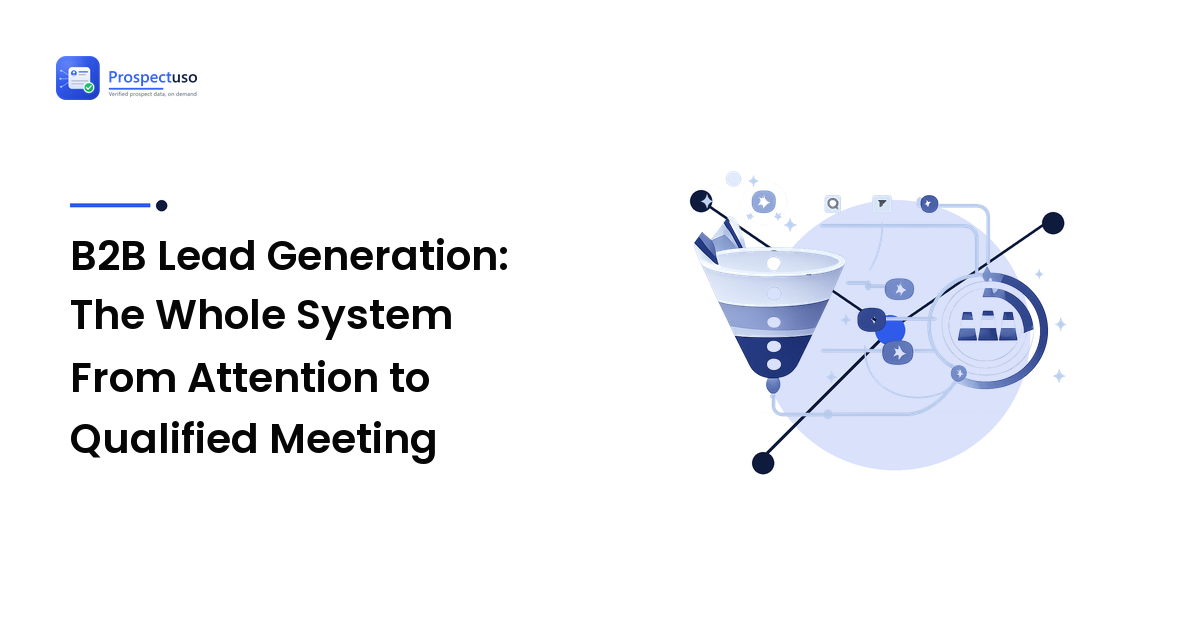
Here's the frame that makes the problem tractable: lead generation is three linked jobs — earning attention, capturing it, and qualifying it — and almost every "lead problem" is a failure of exactly one of the three. A team that knows which job is broken fixes it in weeks. A team that doesn't buys tools, lists, and ad spend at random. This guide maps the whole system so you can find your broken stage and route to the deep-dive that fixes it.
What lead generation actually covers
A lead is a person or account that has entered your world with some plausible chance of buying — a form fill, a reply, a referral, a scanned badge. Lead generation is everything that produces those records and turns the good ones into conversations: demand sources, capture mechanics, and qualification.
It's worth separating from its noisiest subset. Prospecting — building target lists and reaching out cold — is one engine inside lead generation, not a synonym for it. The full discipline also includes the buyers who come to you, the plumbing that catches them, and the filtering that decides who gets a rep's calendar. If outbound is the part you're here for, the sales prospecting playbook covers that craft end to end; this guide is the map it sits on.
The three jobs, concretely:
- Attention — someone who could buy learns you exist and has a reason to care.
- Capture — that flicker of interest becomes a record you can actually work: an identified person, a channel to reach them, and the context of how they arrived.
- Qualification — records get sorted into conversations worth having now, worth nurturing, and worth declining, so selling time lands on real buyers.
Hold every tactic you're pitched against this frame and its job becomes obvious — or its uselessness does.
The two engines: inbound and outbound
All attention comes from one of two engines, and they behave differently enough that confusing them wrecks planning.
Inbound means buyers find you: search content, referrals, reviews, community presence, local visibility. Its economics are compounding — an article or a reputation keeps producing leads long after the work is paid for — and inbound leads arrive with intent, which makes them convert better. Its costs are latency and control: it's slow to start, and you can't choose who shows up. For businesses that sell to a geography, the highest-leverage inbound work is often local: turning local online visibility into real leads walks that playbook.
Outbound means you go to buyers: a defined list, researched touches, a steady cadence. Its economics are linear — leads roughly track effort — but it offers what inbound never can: precision and immediacy. You pick the accounts, and pipeline can exist this month. Its costs are tolerance and reputation: every market has a limited appetite for being contacted, and sloppy volume burns domains and goodwill. The list itself is a real build-or-buy decision with tradeoffs on both sides — buying versus building a prospect list breaks it down.
Neither engine is a religion. The mix is a math problem:
- Deal size sets the floor for outbound. Researched, multi-touch outreach costs real hours per account; small deals can't repay that effort, which is why low-price products lean inbound and self-serve.
- Urgency sets the floor for outbound too. If pipeline must exist this quarter, inbound alone won't get there — its compounding hasn't started yet.
- Market size punishes waste. If your addressable market is a few thousand accounts, spray-and-pray outbound burns through it permanently. Small markets demand careful outbound and patient inbound.
- Start with one engine instrumented, then add the second. Two half-measured engines produce numbers nobody can read.
Capture: stop leaking what you already earned
Capture is the least glamorous job and the most commonly broken one. Attention decays in hours — a buyer who hit your site with a live problem has moved on by tomorrow — so the machinery between "interested" and "in the CRM, being worked" deserves more scrutiny than it gets.
- Ask for less. Every extra form field trades completion rate for data you could get later. Capture identity and context; enrich the rest afterward.
- Answer fast, with a person. Speed-to-lead is the cheapest conversion lever most teams own. A same-hour human reply beats a next-day sequence — assign an owner and measure the gap.
- Test the plumbing on a schedule. Forms, routing rules, and notification emails fail silently, and a broken intake looks exactly like a slow month. The silent contact-form leak covers how these failures happen and the monthly check that catches them.
- Preserve the arrival context. "Downloaded the pricing comparison" and "entered a giveaway" are different leads. If your capture flattens everyone into one bucket, qualification starts blind.
Qualification: the filter that keeps the funnel honest
Unqualified volume is the expensive kind of success: the funnel looks full while reps spend their week on people who were never going to buy. Qualification is a chain with three layers, built in this order.
First, a written definition. Before frameworks or tools, the team needs one agreed sentence for what "qualified" means — who counts, what must be true, and who decides in a dispute. Most funnel arguments are definition arguments in disguise; what "qualified" should mean before a lead reaches your calendar shows how to write the standard down.
Second, a framework for the conversation. BANT, MEDDIC, CHAMP and their cousins are structured checklists for discovering whether the definition is met — budget, authority, need, timing, process. They differ in depth and ceremony, and the right one depends on your deal complexity; the qualification frameworks comparison maps which fits which motion.
Third, scoring — once there's volume. When leads outnumber the hours available to talk to them, scoring decides who gets attention first. Done well, it's your qualification definition made measurable from behavior and fit data; done badly, it's points for opening emails. Lead scoring that predicts who buys covers building the honest version. The sequencing warning matters: scoring installed before the definition exists just automates the confusion.
Run the math backward, from revenue
Skip industry benchmarks — they describe someone else's funnel. Use your own trailing numbers, however rough:
- Revenue target ÷ average deal size = deals needed.
- Deals ÷ your opportunity win rate = opportunities needed.
- Opportunities ÷ your meeting-to-opportunity rate = qualified meetings needed.
- Meetings ÷ your lead-to-meeting rate, per source = leads needed, per source.
If you don't have history, that's the finding: run each engine small, measure honestly for a quarter, and only then scale what the numbers support. A team that knows its own four ratios can spot the broken job in the chain from a single weekly report — which stage's ratio moved.
The weekly rhythm
Review four numbers, weekly, by source: leads created, qualified rate, meetings held, and pipeline created. The qualified rate is the honest column — it's what separates a source that produces buyers from one that produces names. Change one variable at a time, keep what moves meetings, and be willing to kill a source whose qualified rate stays near zero no matter how much volume it delivers.
FAQ
What's the difference between lead generation and prospecting?
Prospecting is the outbound engine — choosing targets and reaching out cold. Lead generation is the whole system: inbound and outbound sources, the capture machinery, and the qualification chain. Every prospector does lead generation; not all lead generation is prospecting.
Should a new company start with inbound or outbound?
Whichever its economics can afford. If deals are large and pipeline is needed soon, start outbound — it's precise and fast. If deals are small or the sales motion is self-serve, start inbound and give it time to compound. Add the second engine only after the first is measured.
Is it okay to buy leads or lists?
Bought contact data can be a legitimate starting point for outbound if it's verified, targeted, and used respectfully — and a liability if it isn't. Buying "leads" who never expressed interest in you specifically usually disappoints, because intent doesn't transfer. Work through the build-versus-buy tradeoffs before spending.
How many leads do we actually need?
Work backward from revenue using your own conversion rates: deals needed, then opportunities, then meetings, then leads per source. The answer is a number you calculate from your funnel, not a benchmark you look up.
How do we know if we have a lead problem or a sales problem?
Check the qualified rate by source. If plenty of leads arrive but few clear your written qualification bar, the problem is generation targeting the wrong people. If qualified meetings happen and deals still die, the problem lives further down the funnel.
Next step
Pick the job that's failing — attention, capture, or qualification — and spend the next two weeks fixing only that one. A funnel diagnosed beats a funnel enlarged. For help building a pipeline system around the fix, see what Prospectuso can do.