A data vendor offers you 50,000 "verified" contacts for the price of a week's coffee. The list arrives instantly, so you can send today instead of researching accounts by hand for three weeks. The temptation is obvious — and so is the trap. Plenty of reps have uploaded a purchased list, watched their bounce rate spike, and torched a sending domain it took months to season.
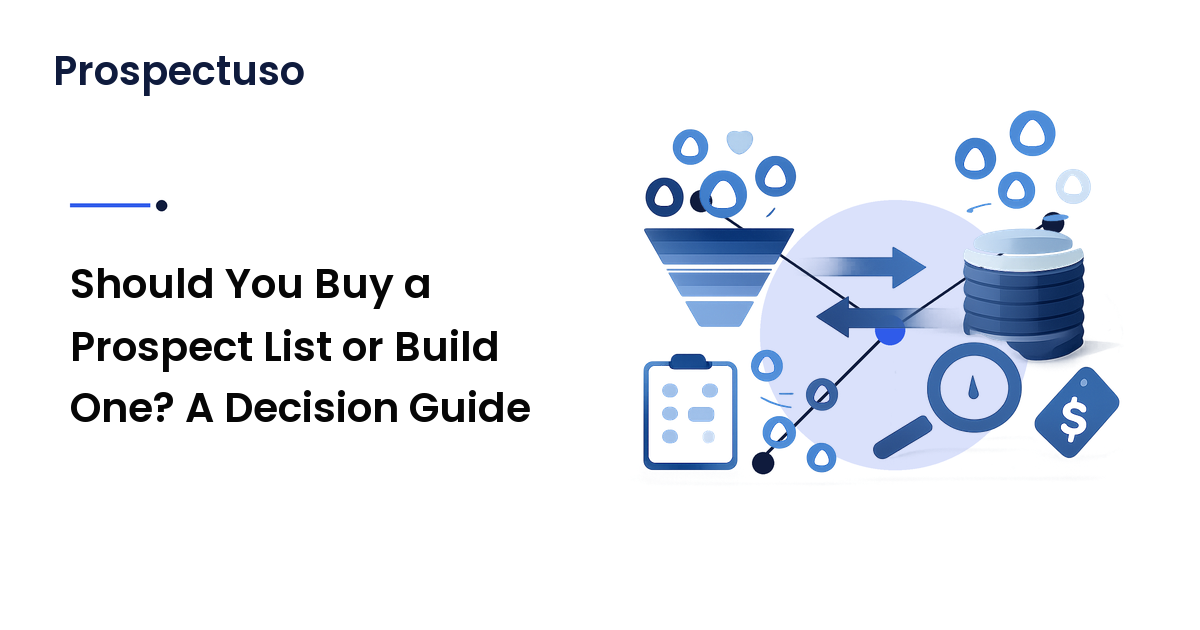
The takeaway up front: buying a prospect list is a tool, not a shortcut — and the real question is never "buy or build" in the abstract, but "is this data accurate, compliant, and well-fit enough to be worth the risk?" A narrowly targeted, recently verified list from a reputable provider can save real time. A cheap dump of scraped, stale addresses costs you far more — in deliverability and wasted hours — than building from scratch ever would.
What "buying a list" actually means
A purchased email list covers a wide spectrum, and conflating the ends is how people get burned. At one end sit scraped or resold email dumps — addresses harvested without permission, sold across countless buyers, riddled with role accounts, dead mailboxes, and spam traps. At the other sit reputable B2B data providers that license firmographic and contact data, refresh it on a cadence, and let you filter to a precise segment (industry, headcount, role, region, tech stack) and export only the records you want.
Those are not the same product and don't carry the same risk. "Never buy a list" really means never touch the scraped-dump end — correct as far as it goes. But when a legitimate provider can hand you accurate, recently verified records, paying for that instead of building by hand is often worth it. The skill is telling the two apart before you pay.
The case for buying
Buying earns its place when speed and coverage matter most:
- You're entering a new market fast and need breadth — a few thousand fitting accounts — before any rep could research them by hand.
- Your ICP is well-defined and filterable by attributes a platform tracks (industry, size, role, location, technology). The tighter your filters, the more useful the export.
- Your team's hours are the bottleneck. If an SDR's time is worth more on personalized outreach than on copying job titles into a sheet, paying for the raw list is simple leverage.
- You'll treat the list as a starting point, not a finished asset — verifying and personalizing before you send.
The logic is leverage: skip the mechanical part of list-building so your people spend their time on what machines can't — relevance.
The case for building
Building your own earns its place when fit and relationship quality matter more than volume:
- Your ICP is narrow or unusual — a few hundred specific accounts, or a segment defined by signals no platform tracks (a recent funding round, a workflow, a hiring pattern). You can spot these; a generic database can't.
- Personalization is your edge. Building account by account, you gather the research as you go — the trigger, the pain, the right person — and that context is what earns replies.
- You care about long-term list health and compliance. A list you assembled and verified yourself stays cleaner, ages more predictably, and gives you a defensible record of where each contact came from.
The logic is ownership: you know the source of every record and the list reflects your judgment of fit, not a vendor's filters. For the full method, see the sales prospecting guide.
The risks people underestimate
Three costs make a cheap list expensive, and all are easy to miss until the damage is done.
Data decay. B2B contact data goes stale fast — people change jobs, companies restructure, mailboxes get retired — so a meaningful share of any list is wrong within a year of being compiled. A list sold as "verified" may have been checked long ago, or never. Stale records mean bounces.
Deliverability damage. This is the one that actually hurts. Sending to invalid addresses drives up your bounce rate, one of the loudest negative signals a mailbox provider reads. Purchased lists also carry spam traps: addresses planted to catch senders who blast unvetted data. Hit a few and you poison the sending reputation all your outreach depends on.
Legal and consent exposure. Outbound to purchased contacts runs into anti-spam and data-protection rules. In some markets, emailing people who never opted in — especially individuals rather than generic business roles — is a regulatory problem, not just an etiquette one. A reputable provider can tell you how data was sourced and what consent basis applies; a scraped dump can't, and that ignorance becomes your liability.
None of these are reasons to never buy. They're reasons to never buy blind — verify, segment, and warm up no matter where the records came from.
How to vet a list (or a provider) before you pay
Whether you're evaluating a vendor or a one-off file, run it through the same gate and buy only what survives:
- Demand a sample first. Never pay for volume you haven't tested. Request a sample matching your exact filters and check it against reality — are the people real, in the stated roles, at the stated companies?
- Measure accuracy and freshness. Run the sample through email list verification and see how many addresses are valid versus risky or dead. Ask, pointedly, when the data was last refreshed — not just whether it's "verified."
- Ask how it was sourced. A credible provider explains where data comes from and what consent or legal basis covers it. Vagueness is a red flag.
- Check fit, not just count. A list of 50,000 loosely-relevant contacts is worse than 2,000 tightly-fitting ones. Judge a provider by how precisely you can filter to your ICP, not by the headline number.
- Plan to verify and warm up regardless. Treat every purchased list as unverified until you've cleaned it yourself, and never point a cold domain at it at full volume.
Vetting collapses the false binary. You're not choosing "buy" or "build" as a philosophy — you're deciding, provider by provider, whether this specific data clears the bar of accurate, compliant, and well-fit. Most of the time the answer is a hybrid: buy the raw coverage where a database genuinely helps, then build on top with your own research before a single message goes out.
FAQ
Is it legal to buy and email a B2B prospect list?
It depends on your market and how the data was sourced. Anti-spam and data-protection rules vary, and emailing individuals who never opted in is riskier than reaching generic business roles. A reputable provider can document the source and consent basis; if a seller can't, treat that as a reason not to buy.
Will a purchased list hurt my email deliverability?
It can, badly, if the list is dirty. Invalid addresses drive up your bounce rate and purchased lists often contain spam traps, both of which damage your sending reputation. The fix is non-negotiable hygiene: verify every record, remove risky addresses, and warm a dedicated sending domain rather than blasting cold data at volume.
How much should a good prospect list cost?
There's no single price, because you're paying for accuracy, freshness, and precise targeting, not raw record count. A small, recently verified, tightly filtered list beats a large cheap dump that bounces. The expensive mistake is a "cheap" list that burns your domain and wastes reps' time chasing dead contacts.
Is it ever better to just build the list myself?
Yes — when your ICP is narrow, defined by signals no database tracks, or when personalization is your edge. Building account by account, you gather the context as you go and control the source and health of every record. Buy for breadth and speed; build for fit and relationship quality.
Next step
Stop framing this as buy versus build and start asking does this data clear the bar. Define one tight ICP, then judge any list — purchased or self-built — by accuracy, freshness, and fit. If you're weighing a provider, request a sample and verify it yourself before paying for volume, and never point a cold domain at an unvetted list. The goal isn't a bigger spreadsheet; it's reaching real, well-fit people without torching the reputation your pipeline depends on. Refine your approach at prospectuso.com.