A prospect ignores your first email, so you assume they're not interested and move on. That single assumption quietly kills more pipeline than any subject line ever did. Silence after one message is the default response to almost all cold outreach — not a verdict on you, your product, or your timing. The reply you wanted is often still on the table, waiting on a touch you never sent.
The takeaway up front: a well-fit prospect usually warrants four to seven touches over two to four weeks, and each one has to give a fresh reason to reply — not just "bumping this" or "did you see my last email." Quitting after one or two messages leaves easy pipeline on the table, but value-free nagging that runs forever is just as wrong — it trains good-fit buyers to filter you out. The skill is knowing how many touches a prospect merits, what each should say, and how to quit cleanly.
Why one-and-done loses the most pipeline
The single biggest follow-up mistake isn't following up too much — it's stopping after the first or second message. A rep sends one cold email, hears nothing, decides the prospect "isn't interested," and crosses them off. But no reply rarely means no interest. It usually means the email arrived during a meeting, got buried under fifty others, or simply wasn't urgent enough to answer right then.
None of those are rejections — they're timing. A relevant follow-up a few days later catches the same person on a calmer morning, and the reply that never came suddenly does. Widely reported outbound benchmarks consistently show a large share of positive responses arriving on follow-ups rather than the opener, so a rep who quits early is throwing away the touches that would have worked — having tested only whether the prospect was free the minute the email landed, not whether they're interested.
How many follow-ups is the right number?
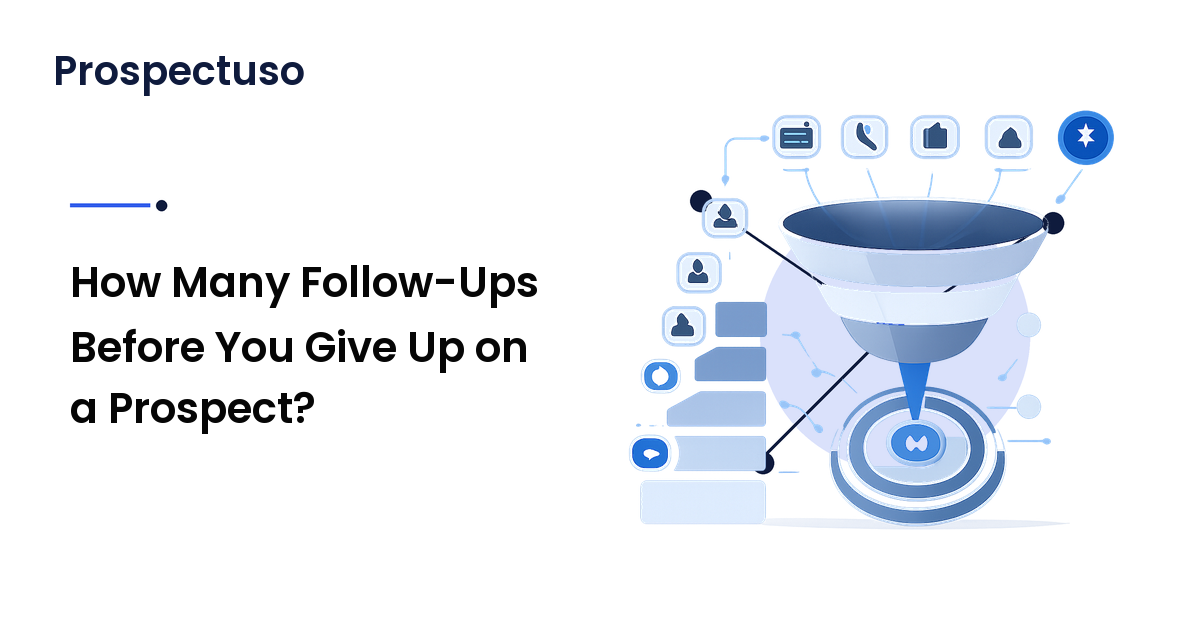
There's no universal magic number, but there is a sensible range. For a genuinely well-fit prospect, four to seven total touches across two to four weeks is a reasonable default for most B2B outbound — the opener plus three to six follow-ups, spaced so you stay present without crowding the inbox.
The right number for your situation moves with a few factors:
- Fit. A perfect-ICP account you know you can help earns the top of the range. A speculative, marginal-fit contact earns the bottom, or fewer.
- Deal size. A large, strategic account justifies more touches over a longer window than a small, transactional one — the effort should track the prize.
- Signal. A real trigger — they're hiring for a role your product affects, or a peer just became a customer — earns more attempts than a list you bought cold.
- Channel mix. Touches spread across email, phone, and a professional network land softer than the same number of emails alone, so a multichannel sequence can run a little longer.
The honest rule: persistence should scale with fit and value, not with how badly you need the number this month.
What each follow-up has to do
This is where most sequences fall apart. The number of touches matters far less than what they say. A follow-up that reads "just bumping this" or "circling back — thoughts?" adds nothing: it makes the prospect re-read your last email while giving them no new reason to bother. Send five of those and you haven't followed up five times — you've annoyed someone five times.
Every follow-up should add something the prospect didn't have before:
- Touch 1 — the opener. A short, relevant reason to reach out that's about them, not your feature list. (The craft of writing this lives in the cold outreach guide.)
- Touch 2 — a new angle. Assume they never read message one, and lead with a different problem you solve or a one-line proof point.
- Touch 3 — useful proof. A specific example of a similar company's result or a concrete observation about their situation. Give before you ask.
- Touch 4 — make replying easy. A low-friction ask: a yes/no question or "is this even a priority this quarter?"
- Touch 5+ — change the channel. If email keeps going silent, a brief, polite call or a message on a professional network can break the pattern an inbox creates.
The test for any follow-up: if this were the only message the prospect ever saw, would it stand on its own and give them a reason to reply? If not, you're nagging, not following up — and adding more of those touches only makes it worse.
When to stop — and how to do it cleanly
Persistence has a ceiling. Past the right number of valuable touches, continuing doesn't win the deal — it erodes the relationship and your reputation. Stop when a full sequence of useful, varied touches has met complete silence, when the prospect turns out not to fit, or the moment anyone asks you to stop. Honor an opt-out instantly and permanently; ignoring one loses the prospect for good and risks your sending reputation.
The clean way to end is the breakup email — a short, no-pressure final message that closes the loop. It works for two reasons. First, it earns replies: the implied "I'll stop reaching out" removes pressure and nudges the people who were interested to finally respond. Second, a gracious close ("I'll leave this here — if priorities change, I'm easy to find") leaves the door open for a later conversation instead of poisoning it.
What a breakup is not is a passive-aggressive jab or a fake-deadline trick; "I'll assume you're not interested and close your file" reads as exactly that. Be genuine: respect their time, leave the offer standing, and move on for now — but mark the account for a fresh look in a quarter. "No reply now" is a timing answer, not a permanent one.
FAQ
How many follow-up emails should I send before giving up?
For a well-fit prospect, four to seven total touches (the opener plus three to six follow-ups) over two to four weeks is a reasonable default for most B2B outbound. Send fewer for marginal-fit contacts and more for high-value accounts. The number matters less than whether each touch adds a fresh, relevant reason to reply.
How long should I wait between follow-ups?
Tighter early, looser later: commonly a few days between the first couple of touches, stretching to a week or more as the sequence goes on. The goal is to catch the prospect on a calmer day, not to appear in their inbox every morning.
Does following up multiple times actually annoy prospects?
Valuable follow-ups don't; repetitive ones do. A message that adds a new angle, proof point, or genuinely easy ask is welcome to a busy buyer who meant to reply. A string of "just bumping this" notes that ask them to do the work is what feels like nagging. Vary every touch and the same count reads as helpful, not pushy.
What is a breakup email and does it work?
A breakup email is a short, no-pressure final message signaling you'll stop reaching out for now. It works well: removing the pressure prompts interested-but-busy prospects to finally respond, and a gracious tone keeps the door open for a future re-approach. Keep it genuine — respect their time, leave the offer standing, and actually stop.
Should I ever follow up after a prospect goes silent for months?
Yes, if their fit is strong and something changes. Silence is usually a timing answer, not a permanent no. A new trigger — a funding round, a new hire, a relevant launch, a peer becoming your customer — is a legitimate reason to open a fresh, well-researched sequence later. Treat it as new outreach with a new reason, not a guilt-trip about the old thread.
Next step
Stop treating silence after one email as a no. Pull a sequence that stalled out, count how many touches it actually got, and ask the harder question: did each one give the prospect a new reason to reply, or were you just bumping the thread? Add the missing follow-ups — a new angle, a proof point, an easy ask, a channel switch — finish with a clean breakup instead of fading out, and mark good-fit non-responders for a fresh look next quarter. Most of the pipeline you think you lost was just waiting on a touch you didn't send. Get the full system at prospectuso.com.