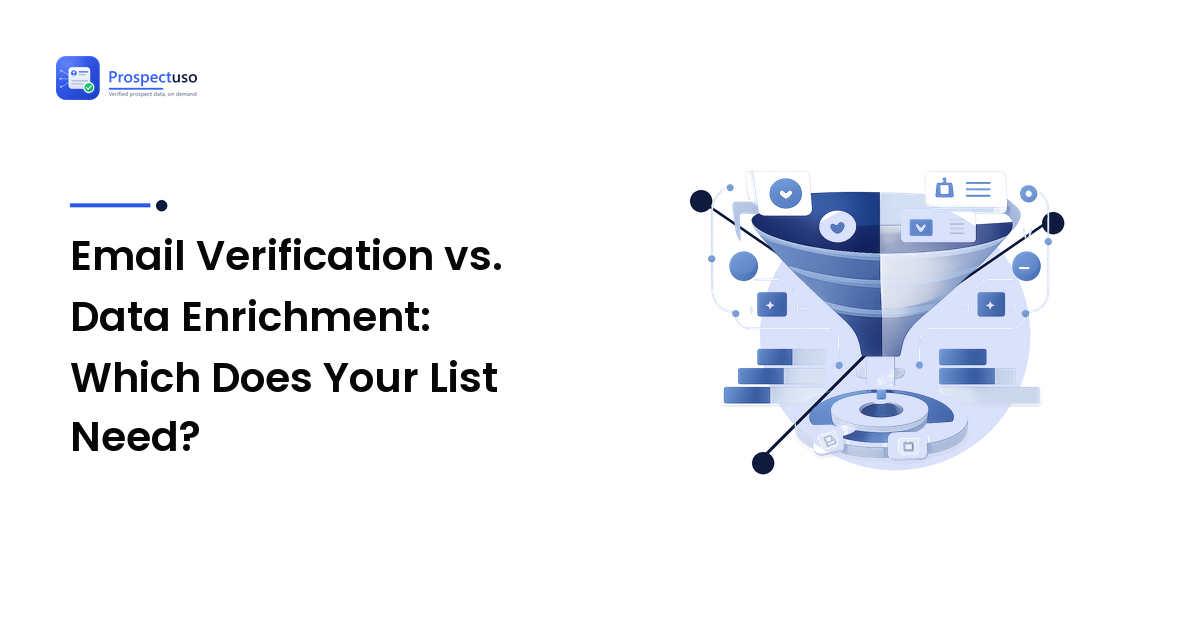
Email verification and data enrichment solve different list problems. Verification checks whether an address will actually deliver — valid, risky, or invalid. Enrichment fills in what's missing or unknown: the right person, their role, the company details behind a domain. If your list bounces, verify. If it's thin or mistargeted, enrich.
Teams conflate the two constantly, then buy the wrong tool and wonder why nothing changed. A deliverable email sent to the wrong job title is still a wasted send; a well-enriched record with a dead mailbox never arrives at all. Both failures look identical on a dashboard — low replies — but they have opposite fixes.
What does email verification actually check?
Verification asks one narrow question: if I send to this address, will it land? A verifier runs layered checks — syntax, whether the domain publishes mail records, whether the mailbox responds at the SMTP level, and whether the address carries risk markers like a catch-all domain, a role account (info@, sales@), or a disposable provider.
The output is usually a status: valid, risky, or invalid. Valid means the mailbox accepted the check; invalid means sending is a near-certain bounce. Risky is the honest middle — catch-all domains accept everything at the server level, so no verifier can confirm a specific mailbox behind them. A good verifier tells you why something is risky rather than guessing.
What verification does not tell you is whether the person is worth emailing. It has no opinion on title, seniority, or fit. It's a deliverability control, not a targeting control — which is why it belongs alongside the authentication and warm-up work in cold email deliverability.
What does data enrichment actually add?
Enrichment starts from a partial record and returns a fuller one. Give it a domain and it can return firmographics — industry, headcount, location, technologies — plus role-based or person-level contacts at that company. Give it a name and company and it can resolve a work email. Give it a stale CRM record and it can flag what's changed.
The value is coverage and accuracy of attributes, not deliverability. Enrichment turns a list of target domains into named humans with titles you can segment by — and it's what makes personalization possible at volume, because you can't reference a prospect's role or stack if you don't know it.
Enrichment has its own failure mode: confident-looking wrong data. Contact data decays constantly as people change jobs and companies restructure, and a provider that returns a guessed pattern email (first.last@domain) without checking it is handing you a plausible-looking bounce. That's why the two functions are usually sold together — and why you should ask any provider whether the emails it returns are verified or merely inferred.
Which one does your list need first?
Diagnose before you buy. Pull a random sample of 200 records from your current list and count two things: how many addresses fail a verification check, and how many are missing a field you'd actually use to target or personalize. Whichever number is bigger is your bottleneck.
| Criterion | Choose email verification | Choose data enrichment | Choose both |
|---|---|---|---|
| Symptom you're seeing | High bounce rate, spam-folder placement, sender reputation dropping | Low reply rate on delivered mail, generic messaging, can't segment | Old list you're reactivating, or a new list from an unvetted source |
| What's broken | Addresses are dead, stale, or risky | Records are incomplete, mistargeted, or unverified | Both accuracy and completeness |
| Core question answered | "Will this land?" | "Is this the right person, and who are they?" | "Is this the right person, and will it land?" |
| Primary metric moved | Bounce rate, deliverability, domain reputation | Targeting precision, personalization depth, segment coverage | Overall list quality |
| Typical input | A list of email addresses | A domain, company criteria, or partial contact | A raw or aged list |
| Typical output | Valid / risky / invalid status per address | Firmographics, contacts, roles, verified work emails | Enriched records with deliverability status |
| When it's the wrong buy | Your list is small but poorly targeted | Your list is well-targeted but bouncing | Budget is tight and one symptom clearly dominates |
| Run it | Before every send, always | When building or refreshing a list | Quarterly on your active database |
The table resolves most cases, but two situations deserve a rule of their own.
Always verify before a send, even on enriched data. Verification is cheap relative to the cost of a bounce spike, and enrichment freshness varies by provider and by record. Treat verification as the last gate in the pipeline, not an optional extra.
Enrich before you personalize, not after. If you're writing sequences off a list with 40% missing titles, you're writing to a fiction. Fix the inputs first — the same logic that makes an ideal customer profile work as filters rather than adjectives.
How do you evaluate a provider for either job?
The buying criteria differ, but the discipline is the same one that applies across your prospecting stack: ask what the tool does to your data, not what it promises about your pipeline.
For a verifier, ask:
- Does it perform SMTP-level checks, or only syntax and domain lookups? Format checks alone catch typos, not dead mailboxes.
- How does it handle catch-all domains? Honest tools label them risky. Ones that report every catch-all as valid are inflating their accuracy number.
- Is there a per-result confidence or reason code? "Invalid" with a reason is actionable; a bare score isn't.
- What's the API and batch story? If verification can't run automatically before a send, it won't run.
For an enrichment provider, ask:
- What's the coverage in your specific segment? Global averages are meaningless if your ICP is mid-market manufacturers in one region. Request a sample and measure.
- Are returned emails verified or inferred? This is the single most important question, and vendors often blur it.
- How fresh is the data, and is a source cited per field? Attribution lets you judge which fields to trust.
- How is it priced — per record, per credit, per seat? Credits burned on records you discard are a real cost.
This overlaps with deciding whether to buy or build a prospect list: in both cases the sample test beats the sales deck. If you're assembling these layers from scratch, the list building tools guide maps where verification and enrichment sit relative to sourcing and sequencing.
What does a combined workflow look like?
For most outbound teams, the sane order is:
- Define the segment from your ICP filters — industry, size, region, role.
- Source accounts as domains or a filtered company list.
- Enrich those domains into named contacts with titles and firmographics.
- Suppress existing customers, open opportunities, unsubscribes, and competitors.
- Verify every remaining address immediately before load-in.
- Route by status — send to valid, exclude invalid, and decide a policy for risky (many teams hold them back from a fresh domain and include them only from a well-warmed sender).
- Re-verify on a cadence for anything sitting in your database longer than a quarter.
Step 7 is the one teams skip. A list verified six months ago is not a verified list — people leave, domains get retired, mailboxes close. Decay is continuous, so hygiene must be recurring, not a one-time cleanup.
FAQ
Can a verifier guarantee an email won't bounce?
No, and be wary of anyone claiming otherwise. Verification dramatically reduces bounces by catching dead and malformed addresses, but mailboxes can be deactivated between the check and the send, and catch-all domains can't be resolved to a specific mailbox at all. Treat verification as strong risk reduction, not a guarantee.
What should I do with "risky" addresses?
Decide by sender health. If you're sending from a well-established, warmed domain with a low bounce history, a controlled portion of risky addresses is usually manageable. If your domain is new or your reputation is already shaky, exclude them entirely until the fundamentals are solid. Never dump a large block of unverified risky addresses into a fresh sender.
Does enrichment help deliverability at all?
Indirectly. Enrichment doesn't check mailboxes, but better targeting produces more engagement — opens, replies, fewer spam complaints — and engagement is a signal mailbox providers weigh. So enrichment can improve inbox placement over time by making your mail more wanted, while verification protects it directly by preventing bounces.
How often should I re-verify my database?
Quarterly is a reasonable default for records you actively email, and always immediately before a campaign regardless of when the list was last cleaned. Contact data decays continuously as people change roles, so any fixed interval is a floor rather than a guarantee — high-churn industries warrant more frequent passes.
Next step
Run the sample test this week. Pull 200 random records from your active list, verify them, and separately count how many are missing a field you'd genuinely use for targeting or personalization. If the bounce number dominates, your problem is hygiene. If the missing-field number dominates, your problem is coverage. If both are ugly, fix verification first — a bounce costs you the sender reputation you'll need for everything else. Enrich any domain into verified contacts with Prospectuso at prospectuso.com.